Last Updated Jan.8/99
Early FORTRAN compilers contained many errors and were not always efficient in their use of computer resources. Moreover, several manufacturers offered variations of FORTRAN that could be used only on their particular computers. Although many improvements were made, early implementations of FORTRAN continued to suffer from this lack of standardization. In response to this problem, the American National Standards Institute laid the groundwork for a standardized FORTRAN. In 1966, two standard versions of FORTRAN were recognized, ANSI FORTRAN and Basic FORTRAN. A more recent version, FORTRAN 77, provides more enhancements to the language. A new FORTRAN standard (FORTRAN 8X) is also under consideration by the American National Standards Institute. In spite of the attempts to standardize FORTRAN, however, most computer manufacturers have continued to offer their own extensions of the language. Therefore, compatibility of FORTRAN programs remains a problem today.
In 1957, when the language was first released,
computers were used primarily by engineers, scientists, and
mathematicians. Consequently, FORTRAN was developed
to suit their needs and its purpose has remained
unchanged. FORTRAN is a procedure oriented language with
extraordinary mathematical capabilities. It is especially applicable
when numerous complex arithmetic calculations are necessary. In
general, FORTRAN is not a good business language. Its capabilities
are not well suited to programs involving file maintenance, data
editing, or document production. However, use of FORTRAN is
increasing for certain types of business applications, such as
feasibility studies, forecasting, and production scheduling. Another
disadvantage of FORTRAN is that it does not resemble English as
closely as many high-level languages; therefore, the programs must be
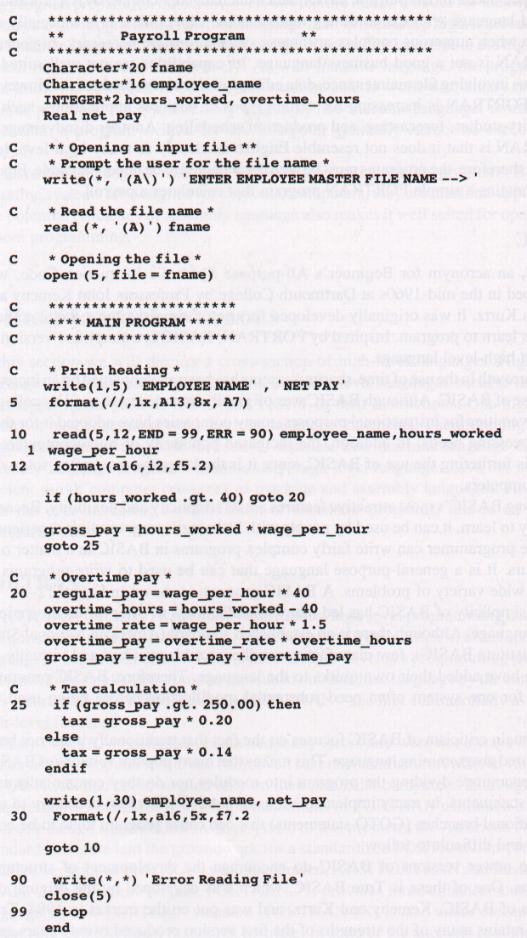
well documented to be understandable. The Figure below contains a
simple FORTRAN program that calculates a payroll.