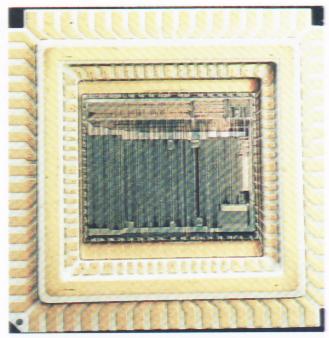
ROM Chip
When functions are built into the hardware of a computer, they are placed in read-only memory (ROM). Read-only memory instructions are hard-wired and cannot be changed or deleted by other stored-program instructions. Since ROM is permanent, it cannot be occupied by common stored-program instructions or data and can only be changed by altering the physical construction of the circuits. Sometimes ROM chips are called firmware. Building instructions into ROM makes the distinction between hardware and software less clear-cut (see Figure below).
ROM Chip
Microprograms are a direct result of hard wiring. Microprograms are sequences of instructions built into read-only memory to carry out functions (such as calculating square roots) that otherwise would have to be directed by stored-program instructions at a much slower speed. Although some machines can be programmed by users at the microprogram level, microprograms are usually supplied by computer manufacturers and cannot be altered by users. Vendors can, however, tailor microprograms to meet the specific needs of users. If all instructions that a computer can execute are located in ROM, a new set of instructions can be obtained by changing the ROM. When selecting a computer, users can get the standard features of the machines plus their choice of the optional features available through microprogramming.
Read-only memory is different from nondestructive read. With nondestructive read, items stored in memory can be read repeatedly without loss of information. New items can then be stored over old ones if the stored program instructs the computer to do so. Read-only memory, on the other hand, is hard-wired into the computer and can only be changed by rewiring.
A version of ROM that can be programmed by the end
user is programmable read-only memory (PROM). PROM can be
programmed by the manufacturer, or it can be shipped "blank" to
another company that will program it for use by the end user. Once
programmed, its contents are unalterable. With PROM the end user has
the advantages of ROM along with the flexibility to meet unique
needs. A problem with it, though, is that mistakes programmed into
the unit cannot be corrected. To
overcome this drawback, erasable programmable
read-only memory (EPROM)
has been developed (see Figure below).

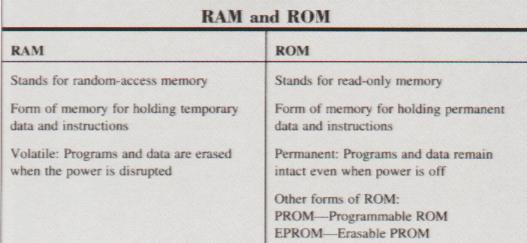
EPROM can be erased but only when it is submitted to a special process, such as being bathed in ultraviolet light. The Concept Summary below presents a review of RAM and ROM.