As with a single CPU and its terminals, a network's CPUs can be hooked together to form either local or remote systems. All networks are comprised of two basic structures: nodes and links. A node refers to the end points of a network. Nodes consist of CPUs, printers, terminals, and other physical devices. Links are the communication channels that connect the nodes.
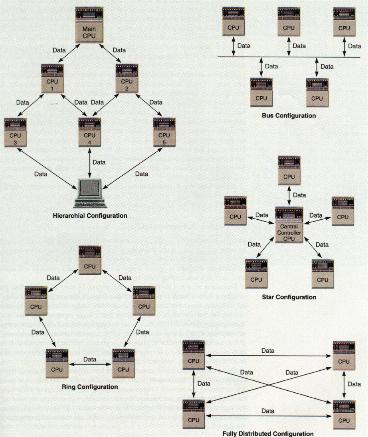
Nodes and links can be arranged in a number of different ways to form a network configuration or topology. Some of the more common are star, ring, hierarchical, bus, and fully distributed. The figure below illustrates these configurations.
In a star configuration, all transactions must go through a central computer before being routed to the appropriate network computer. This creates a central decision point, which facilitates workload distribution and resource sharing but exposes the system to single-point vulnerability. When the central computer breaks down, all the nodes in the network are disabled. An alternative approach uses a number of computers connected to a single transmission line in a ring configuration. This type of system can bypass a malfunctioning unit without disrupting operations throughout the network.
A more sophisticated approach is the hierarchical configuration, which consists of a group of small computers tied into a large central computing complex. Under this approach, an organization's needs are divided into multiple levels, which are controlled by the single computer at the top of the hierarchy. The lowest level is the user level, where only routine transaction-processing power is supplied. This level is connected to the next higher level and its associated information system. At each level, the machine size increases while the need for distribution decreases. In a bus configuration, each computer plugs into a single bus cable that runs from computer to computer. Each computer must have its own interface that connects it to the network. As messages travel along the bus cable, stations monitor the cable and retrieve their own messages. If one node in a bus configuration breaks down, the system can still function effectively.
A fully distributed configuration is one in which every set of nodes in the network can communicate with every other set of nodes through a single communication link. Each local system has its own processing capabilities.