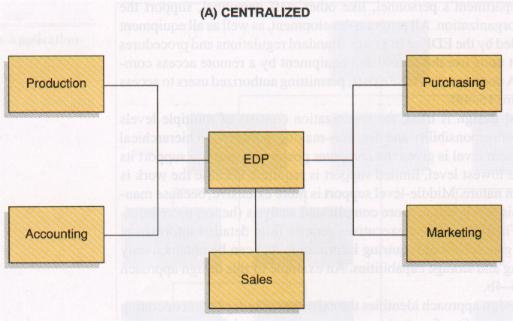
The centralized design is the most traditional approach. It involves the centralization of computer power. A separate electronic data processing (EDP) or information systems (IS) department is set up to provide data processing facilities for the organization. This department's personnel, like other staff personnel, support the operating units of the organization. All program development, as well as all equipment acquisition, is controlled by the EDP or IS group. Standard regulations and procedures are employed. Distant units use the centralized equipment by a remote access com-munication network. A common data base exists, permitting authorized users to access information (see Figure below).
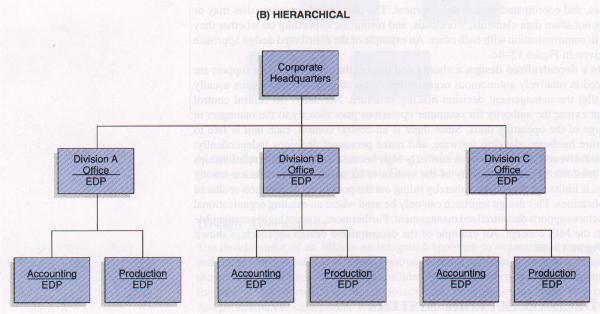
When hierarchical design is used, the organization consists of multiple levels with varying degrees of responsibility and decision making authority. In hierarchical design, each management level is given the computer power necessary to support its task objectives. At the lowest level, limited support is required, because the work is considered technical in nature. Middle level support is more extensive, because managerial decisions at this level require more complicated analysis (hence, more infor-mation processing). Finally, top level executives require little detailed information since they work with general issues requiring information that can be obtained only with greater processing and storage capabilities. An example of this design approach is shown in the Figure below.
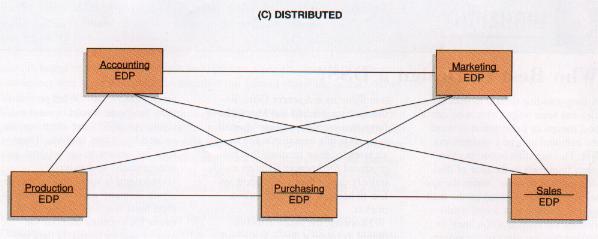
The distributed design approach identifies the existence of independent operating units but recognizes the benefits of central coordination and control. The organization is broken into the smallest activity centers requiring computer support. These centers may be based on organizational structure, geographical location, functions, operations, or a combination of these factors. Hardware (and often people) are placed within these activity centers to support their tasks. Total organization wide control is often evidenced by the existence of standardized classes of hardware, common data bases, and coordinated system development. The distributed computer sites may or may not share data elements, workloads, and resources, depending on whether they are in communication with each other. An example of the distributed design approach is given in the Figure below.
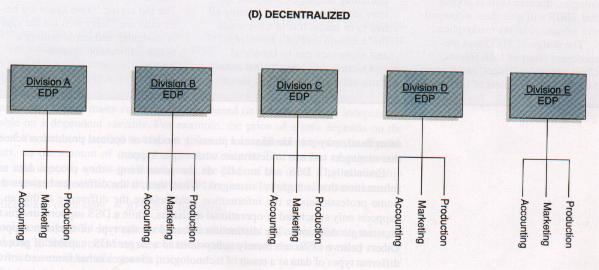
In a decentralized design, authority and responsibility for computer support are placed in relatively autonomous organizational operating units. These units usually parallel the management decision making structure. Normally, no central control point exists; the authority for computer operations goes directly to the managers in charge of the operating units. Since there is no central control, each unit is free to acquire hardware, develop software, and make personnel decisions independently. Responsiveness to user needs is normally high because close working relationships are reinforced by the proximity of the system to its users. Communication among units is limited or nonexistent, thereby ruling out the possibility of common or shared applications. This design approach can only be used where an existing organizational structure supports decentralized management. Furthermore, it is not highly compatible with the MIS concept. An example of the decentralized design approach is shown in the Figure below.